Reach Volunteering is closing. We should all be worried about this.
Updated: Sep 2
An open letter to funders, policymakers and business leaders
The closure of Reach Volunteering is devastating news for the charity sector. And it is something we should all be worried about.
Because Reach is not closing because it is no longer needed. Quite the opposite. Reach is closing when business is booming.
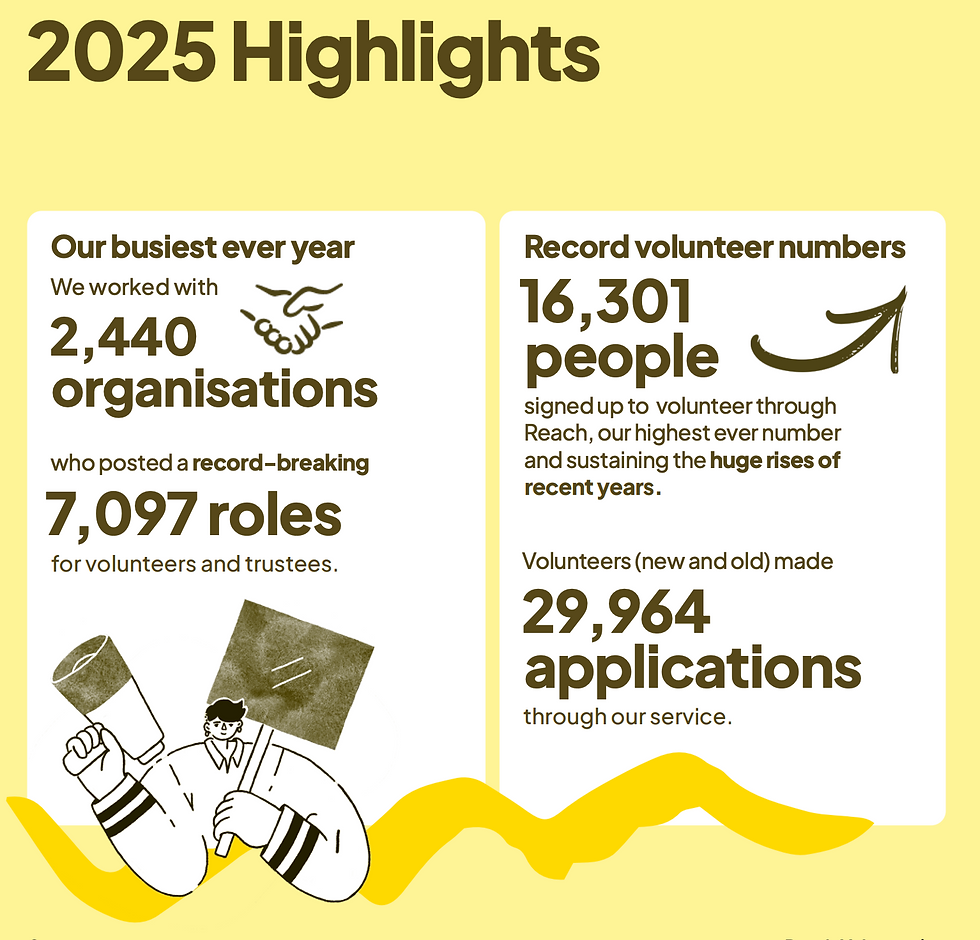
In 2025 alone, more than 16,000 new volunteers registered (4 times the numbers before the pandemic) and nearly 30,000 applications were made by people wanting to use their skills for good. A record 5,996 volunteers and trustees were recruited, and 2,440 charities and community organisations used the platform.
Importantly, 9 out of 10 charities said the volunteers they recruited through Reach made their organisations more effective.
Those numbers tell us something clearly: charities need skilled volunteers, and there are thousands of people who want to help. Yet it is not always that simple.
For a small charity, finding the right volunteer can be transformational. A volunteer might overhaul its finances, strengthen its governance, develop a fundraising strategy or transform its marketing. But finding that person can be time-consuming and difficult - particularly for organisations with only one or two members of staff, or none at all.
For volunteers, the problem is often the reverse. Lots of people want to volunteer, but one of the biggest barriers we hear at Charterpath is: “I don't know where to start.” What role could I do? Where should I look? Which charity needs my skills?
Reach made both sides of that equation easier. For nearly half a century, it connected charities and community groups with people who wanted to volunteer their expertise. It became the largest source of trustees for the sector, while helping small organisations recruit beyond their immediate networks and reach a far wider and more diverse pool of people.
It was, quite simply, the infrastructure that helped turn willingness to volunteer into action.
So if the charities still need the service and volunteers are still signing up to get involved, why is Reach closing?
The problem with funding charities who support other charities
Reach's service was free for volunteers and free for most of the charities and organisations using it. That accessibility was fundamental to their model to avoid adding more barriers to volunteering.
But of course, free to the user does not mean free to provide. Technology needs maintenance, Volunteers and charities need support. Reach therefore depended on funders and partners investing in the infrastructure that made all those thousands of connections possible.
And this is where, as a country, we have a much bigger problem.
In its closure announcement, Reach talks about a shifting funding landscape in which funders have increasingly "narrowed their focus towards particular places, issues and groups". Funding charities whose role is to help other charities is increasingly unpopular.
The impact that one volunteer can have on a charity - transforming its funding arrangements, improving its governance, upgrading its marketing - is not tangible enough or easy enough to quantify at scale. Or maybe volunteering just isn’t a ‘sexy’ enough cause these days. People want grit and clear bang for their buck, knowing that their donations have provided meals for 1,000 families, bought a piece of medical equipment or directly supported 500 young people. The impact needs to be clear and visible.
Funding an organisation that helped a charity recruit a treasurer who subsequently improved its financial management, helped it secure more funding, strengthened its governance and enabled it to support more people for the next five years is much harder to photograph and celebrate (although to be fair Reach did a pretty brilliant job of it).
The irony is that supporting infrastructure organisations like Reach is precisely where returns can be multiplied. Investing in Reach helped thousands of charities find volunteers who (in the majority of cases) will helped maximise their impact for the communities and groups they served.
And those volunteers don't necessarily stop with one organisation. People who volunteer have a tendency to get hooked on giving back. Someone who becomes a trustee at 35 may go on to support charities for another 30 or 40 years. That is an enormous multiplier effect. Reach estimates that for every £1 invested in its work, £80 of professional skills were contributed by volunteers.

What happens without this volunteering infrastructure?
Reach's closure leaves a very real gap. Charities will still need trustees and they will still need volunteers with finance, marketing, technology, HR, fundraising, legal and strategic skills. People will still want to volunteer those skills. But connecting the two has just become a lot harder.
Some charities will spend more time advertising roles across multiple platforms. Some will spend more money on recruitment they can’t really afford. Some will fall back on their existing networks, making it harder to diversify their boards and volunteer teams.
And some simply won't find the person they need.
35% of the roles advertised by Reach Volunteering came from organisations run entirely by volunteers. These are organisations with very little spare capacity to absorb more work. And they are already under enormous pressure.
Small charities do not sit at the margins of the charity sector. They represent 80% of charities in the UK. And Small Charity Week research found that nearly half of small charities fear closure within 12 months. That should worry all of us.

What happens when small charities disappear?
It is very easy to think of charities as somehow separate from the essential infrastructure of society. They aren't.
Charities and community groups are the glue that helps hold our societies together. They run youth clubs and foodbanks. They support victims of domestic abuse. They provide mental health services. They look after community spaces, support disabled children, visit isolated older people and help families through crises. When they disappear, communities start to break up.
The recent violence in Middlesbrough has highlighted the consequences of long-term disinvestment in young people and communities - which leaves behind gaps for organised crime to fill.
Strong communities don't just happen. They require investment and funding.
Reach is not the first warning
In recent years the sector has lost the Small Charities Coalition and Getting on Board which served to support charity trustee boards. Now Reach Volunteering.
These are organisations whose entire purpose was to make other charities stronger.
The foundations which support the civil society are gradually being eroded and no one beyond the immediate charity users seems to care.
So this is our ask
To grant-makers:
Please look again at how you fund infrastructure.
Funding a charity which supports thousands of other charities may make attribution more difficult, but that does not mean the impact is less real. Consider the multiplier. Fund core costs. Fund organisations for long enough to build sustainable services rather than forcing them endlessly from one short-term grant to another.
To business leaders:
If your organisation talks about purpose, social impact, employee volunteering or responsible business, invest in the mechanisms that enable those things to happen.
Corporate Social Responsibility means more than sending a team to paint a community centre for a day. Businesses have money, skills, technology, networks and people that the charity sector desperately needs. Supporting organisations which connect those resources with communities can create impact far beyond a single corporate volunteering day. Look at organisations such as Charterpath, Pilotlight, LinkUP London, Young Trustees Movement and other organisations operating in your own communities.
And to government:
Recognise that volunteering infrastructure is critical infrastructure.
If we want stronger communities, better governed charities and more people participating in civic life, then the organisations that enable that participation cannot continually be expected to survive on goodwill and short-term funding.
Reach has said itself that it hopes its closure prompts a serious conversation between funders, policymakers and sector leaders about how this infrastructure will be sustained.
This conversation must happen. Because as this infrastructure disappears, rebuilding it will cost far more than sustaining it ever would have done.
And finally
We cannot replace Reach, and nor would we pretend to. But if you are looking for volunteers with financial skills - whether as trustees, treasurers, independent examiners or for shorter-term projects - please do get in touch with Charterpath and we will do everything we can to help connect you with the right people.
About Charterpath
Charterpath CIO is a UK registered charity (1207509) charting a path between non-profits and volunteers with financial skills. Charterpath was co-founded by Alice Clementi and Alex Marsh, both chartered accountants with extensive volunteering and fundraising experience alongside their professional careers. They were inspired to start Charterpath in 2020, after seeing first-hand the unprecedented financial challenges facing the non-profit sector from the pandemic.
Inspired to support our mission?
Follow Charterpath on LinkedIn and join our community at www.charterpath.org.uk to access our newsletter, exclusive events and volunteer roles!


